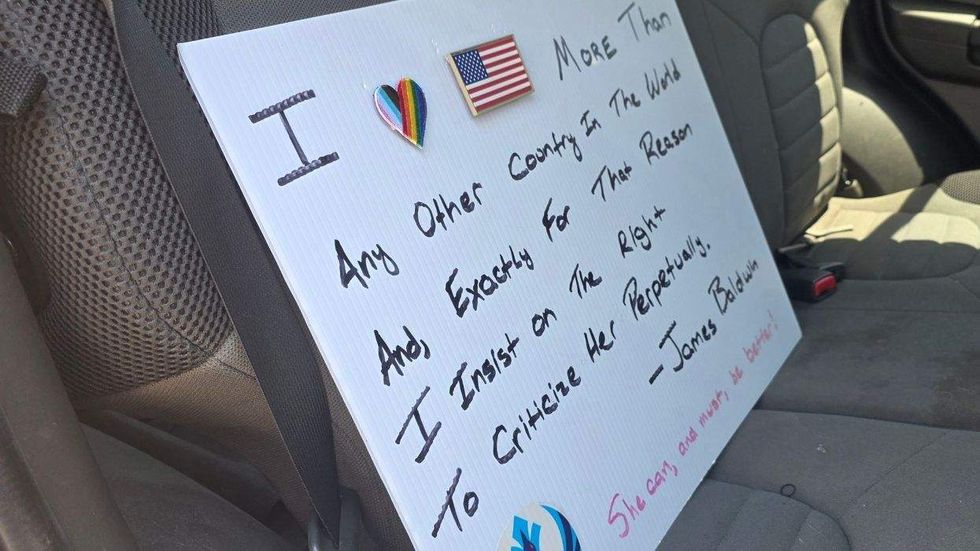
There is a protest sign in the back of my car. It has been to courthouse squares, to highway overpasses, to small towns. It’s too long to be a truly great protest sign, but I take it everywhere. It carries one sentence, from James Baldwin:"I love America more than any other country in the world, and, exactly for this reason, I insist on the right to criticize her perpetually."I made the sign because Baldwin put into one sentence what I’ve spent a career trying to live. Twenty-three years in uniform. An oath taken again and again, never to a person, always to an idea. When people ask how I can criticize a country I served, I want to hand them the sign.Criticism is not the opposite of patriotism. It is the evidence of it.Today, America turns 250. There will be fireworks; I’ll go. There will be parades; I’ll march. There will be speeches about how far we have come. Much of the praise will be earned. 250 years ago, America ushered in a historical anomaly: a government of ideas rather than blood, built on revolution. An anniversary like this tempts us to treat the founding story as ending with a period rather than a comma.Read the Declaration again. Not the poetry at the top. The engineering underneath it:"That to secure these rights, Governments are instituted among Men, deriving their just powers from the consent of the governed, --That whenever any Form of Government becomes destructive of these ends, it is the Right of the People to alter or to abolish it, and to institute new Government, laying its foundation on such principles and organizing its powers in such form, as to them shall seem most likely to effect their Safety and Happiness."We remember the self-evident truths. We overlook the operating instructions. The founders did not declare a perfect system into being. They declared a right. When government stops serving its ends, the people may redesign it.Government is not sacred, nor are the rules of its operation. Its purpose is.Look closely at one phra
Patriotism means criticizing America and making it better
This is a summary from The Advocate. Read the complete article on their website.
Read Full Article on The Advocate
Opens in a new tab. QueerLine is not responsible for third-party content.
The Advocate
This article was automatically aggregated from The Advocate, a trusted LGBTQ+ news outlet. QueerLine curates headlines from verified sources to keep the community informed.