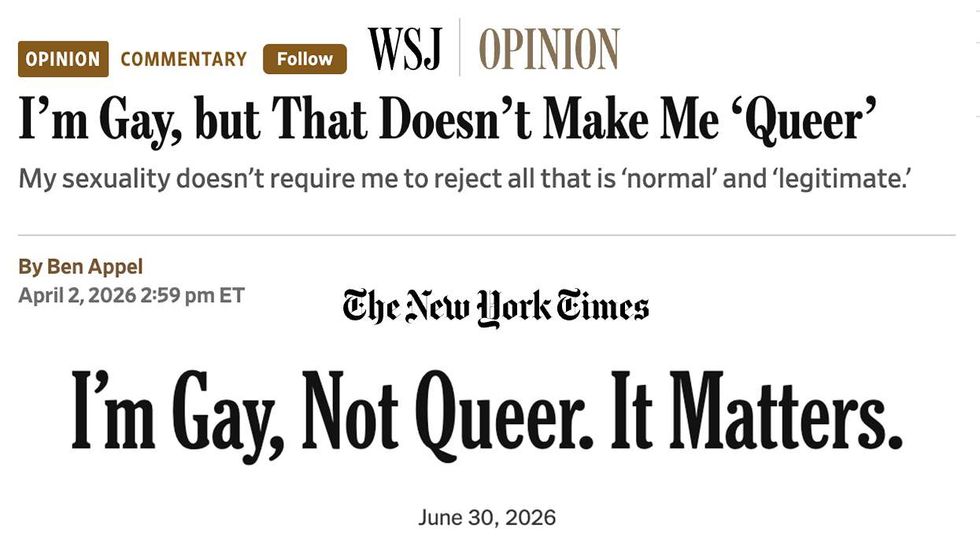
Another day, another think piece by a gay man distancing himself from queerness. If it feels like we were just here, it's because we were.Three months after The Wall Street Journal published an essay arguing, "I'm Gay, but That Doesn't Make Me 'Queer,'" The New York Times has now published a remarkably familiar variation: "I'm Gay, Not Queer. It Matters."The arguments take different paths to arrive at the exact same destination. In WSJ, Ben Appel warns readers about queer theory and academic radicalism. In NYT, Matthew Vines argues that the language of queerness is undermining public support for marriage equality. One frames queerness as ideological excess while the other recasts it as a political liability. But both ultimately deliver the exact same message: Gay is respectable, queer is the problem.Within months of one another, The Wall Street Journal and The New York Times have each devoted coveted opinion space to essays urging readers to separate "gay" from "queer."Taken together, they don't simply reflect a debate inside the LGBTQ+ community. They elevate a familiar respectability narrative that distills queer life into something cleaner, safer, and more acceptable to the mainstream while treating everything outside that frame as an embarrassment to be quietly pushed back into the closets and shadows.These editorial choices deserve scrutiny. After years of criticism over whose voices these institutions elevate on LGBTQ+ issues, including widespread backlash over The New York Times' coverage of transgender people, both papers have now amplified different versions of the same argument: that queerness itself has become the problem. At a moment when LGBTQ+ rights are under coordinated political attack, it is remarkable that two of America's largest newspapers have chosen to devote their platforms not to confronting that assault, but to publishing essays that ask gay people to distance themselves from the broader community that fought to make their acceptance possib
Why are America's largest newspapers stigmatizing queer people?
This is a summary from The Advocate. Read the complete article on their website.
Read Full Article on The Advocate
Opens in a new tab. QueerLine is not responsible for third-party content.
The Advocate
This article was automatically aggregated from The Advocate, a trusted LGBTQ+ news outlet. QueerLine curates headlines from verified sources to keep the community informed.