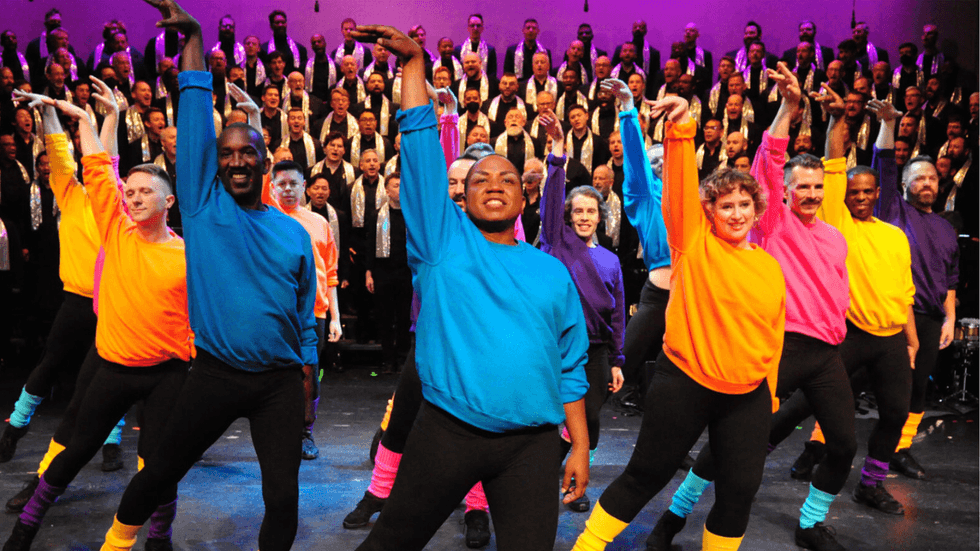
On a rehearsal night in 1981, a group of singers in Washington, D.C., gathered to do something that sounds simple now, but was anything but simple then — they stood together and sang, publicly and proudly, as gay men.Some of their names could appear in a concert program. Some could not. Being associated publicly with a gay organization in the nation’s capital carried real risk. In a time when being known as queer could cost someone a job, a family, a home, or a future, they came together anyway.Five days after the Gay Men’s Chorus of Washington, DC (GMCW) was founded on June 28, 1981, the first public reports of what would become the AIDS crisis appeared in the press. What began as a chorus quickly became something larger: a community, a refuge, a record of survival, and a place where queer people could insist on being heard when the world chose fear, silence, or abandonment. Performers from the Gay Men’s Chorus of Washington, DC sing and dance on stageGMCW45 years later, a different rehearsal room tells a connected story. Young singers in GMCW’s GenOUT Youth Chorus stand before thousands of people with adult members of GMCW behind them, literally and symbolically, showing them through presence alone that queer adulthood is possible. That joy can last, that community can hold, that a hostile political moment is not the whole story.In conversations with GMCW Chorus member and historical chair Chuck Willett, GenOUT alum and GMCW Chorus member Anjali Murthy, and Nashville Major Minors Artistic Director Matthew Pyles, they reinforced the idea that LGBTQIA+ choruses give queer people of different generations a place to find one another, learn from one another, and help one another imagine a future.After the 2024 election, more than 50 adult GMCW Chorus members attended a GenOUT Youth Chorus rehearsal. For the first hour, they did not rehearse; they listened. Young singers spoke about fear, uncertainty, and the helplessness of being affected by political decisio
45 years later, queer choruses still help LGBTQ+ youth find hope
This is a summary from The Advocate. Read the complete article on their website.
Read Full Article on The Advocate
Opens in a new tab. QueerLine is not responsible for third-party content.
The Advocate
This article was automatically aggregated from The Advocate, a trusted LGBTQ+ news outlet. QueerLine curates headlines from verified sources to keep the community informed.